15 Oslo Hotels, Including the One Where Ibsen Ate Lunch
The Karl Johans gate grand dame where the Nobel laureate waves from the balcony, a shipping line’s headquarters where emigrants bought passage to New York, a 1917 theatre with its stage still running, and two national thank-you gifts on the Holmenkollen ridge.
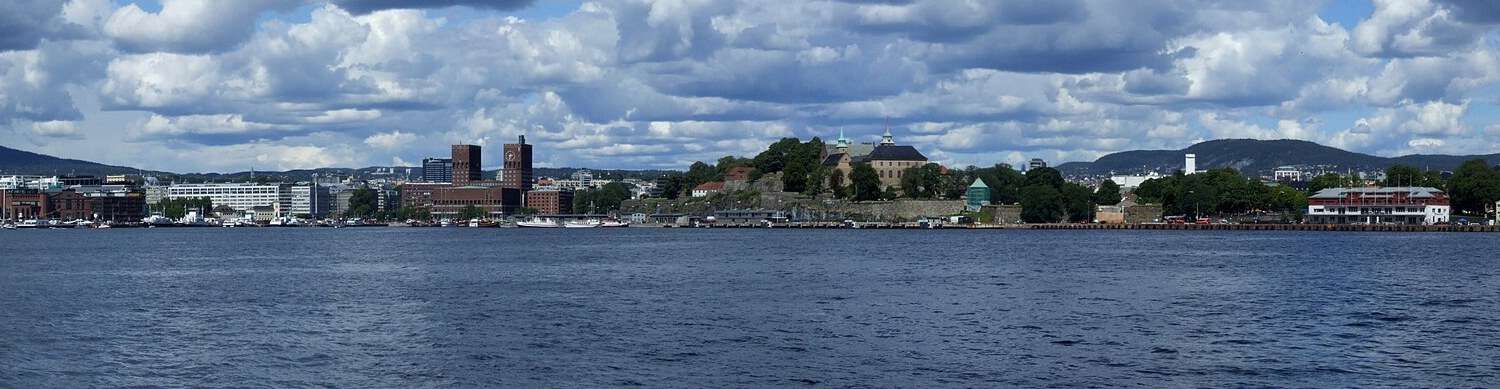
Oslo’s hotels carry the city’s own story: Ibsen’s lunch table, the emigrants’ shipping office, the electricity works, and two houses given as thanks after the war. This list has the Grand, where the Nobel Peace Prize laureate greets the torchlight procession each December, Amerikalinjen in the Norwegian America Line’s 1919 headquarters, Sommerro in the old Oslo Lysverker building with its restored public bath, and Voksenåsen, Norway’s gift to Sweden on the ridge above Holmenkollen.
The list is grouped by character, not ranked. Each hotel’s name links to its own site, so you see the current rate and book direct.
The grand dames of the centre
Grand Hotel Oslo by Scandic · Sentrum / Karl Johans gate
The Grand opened in 1874 on Karl Johans gate facing the Parliament, and the Grand Café was Henrik Ibsen’s daily lunch table in the 1890s. Per Krohg’s 1928 mural in the café shows Ibsen, Munch and the Kristiania bohemians who drank there. The Nobel Peace Prize laureate stays here each December and greets the torchlight procession from the balcony.
Hotel Bristol · Sentrum / Kristian IVs gate
The Bristol opened in 1920 on Kristian IVs gate and is now run by Thon Hotels. The Bibliotekbaren library bar and the winter garden open off a Moorish-style hall that survives from the original interior. It has long been billed as Oslo’s literary and jazz living room.
Hotel Continental · Sentrum / Stortingsgata
The Continental opened in 1900 opposite the National Theatre and has been run by the same family for four generations, today under Elisabeth Brochmann. The Theatercaféen, a Vienna-style café from 1900, is part of the hotel, and one of Norway’s larger private collections of Edvard Munch works hangs in its bar and lounges.
Hotell Bondeheimen · Sentrum / Rosenkrantz’ gate
Bondeheimen opened in 1913 and is still owned by Bondeungdomslaget i Oslo, the rural youth association that built it to give country people a home in the capital. Kaffistova, the attached café, serves traditional Norwegian dishes and predates the hotel. It calls itself Oslo’s culture hotel, with Nynorsk and folk craft as its identity.
Buildings with a past life
Amerikalinjen · Sentrum / Jernbanetorget
Amerikalinjen occupies the 1919 headquarters of the Norwegian America Line at Jernbanetorget, where emigrants bought passage to New York. Andreas Bjercke and Georg Eliassen designed it, the same pair behind the Oslo Lysverker building that is now Sommerro. It opened as a hotel in 2019 after the building had stood largely idle for decades, by the hotel’s account.
Sommerro · Frogner / Solli plass
Sommerro is set in the 1931 headquarters of Oslo Lysverker, the city electricity works, designed by Bjercke and Eliassen. The restored Vestkantbadet public bath, with Per Krohg frescoes, is now the hotel spa. Villa Inkognito, a separate villa across the street, serves as the hotel’s private annex.
Hotel Christiania Teater · Sentrum / Stortingsgata
The Christiania Teater was built in 1917 as a theatre at Stortingsgata 16, and the stage still operates inside the building. As the Filmteatret cinema it served as the German occupiers’ showcase venue during the war. The theatre interior is protected by the Norwegian Directorate for Cultural Heritage.
Home Hotel Folketeateret · Sentrum / Youngstorget
The Folketeateret building on Youngstorget is a functionalist landmark completed in 1935 by the architects Christian Morgenstierne and Arne Eide. The theatre was home to the Norwegian National Opera from 1959 until it moved to Bjørvika in 2008. The hotel traded as the Clarion Collection Hotel Folketeateret until Strawberry rebranded the chain as Home Hotel in 2025.
Comfort Hotel Grand Central · Sentrum / Oslo S
The Grand Central is built into Østbanehallen, the 1882 east railway station hall that is now part of Oslo Central Station. The rooms sit above the old station concourse, and guests walk out onto the platforms.
Villas, small houses and an art hotel
Camillas Hus · Sentrum / Slottsparken
Camillas Hus is a small hotel in a protected nineteenth-century house on Parkveien beside the Royal Palace park. It is named for Camilla Collett, the pioneering Norwegian feminist novelist, who the hotel says lived in the house, which it dates to the 1840s.
Home Hotel Gabelshus · Frogner
Gabelshus is an ivy-covered brick villa from 1912 in the Frogner embassy district. It has operated as a hotel since 1945, by its own account, furnished with antiques in English manor style. It traded as the Clarion Collection Hotel Gabelshus until the 2025 Home Hotel rebrand.
The Thief · Tjuvholmen / Aker Brygge
The Thief opened in January 2013 on Tjuvholmen, the islet whose name means Thief Island, after the eighteenth-century executions held there. Petter Stordalen built it next to the Renzo Piano-designed Astrup Fearnley Museum, with works by Warhol, Hirst and others on display in the hotel.
On the hills above the city
Scandic Holmenkollen Park · Holmenkollen
The dragon-style timber building was raised in 1894 as the Holmenkollen Sanatorium for Dr Ingebrigt Christian Lund Holm, to a design by Balthazar Lange. It became a tourist hotel in 1914 after the original Holmenkollen Turisthotell burned down twice, and was extended in 1982 as the Holmenkollen Park Hotel, a few minutes from the ski jump.
Lysebu · Holmenkollen / Voksenkollen
Lysebu is owned by the Danish-Norwegian Cooperation Fund, set up in 1946 with the surplus from Danish wartime relief to Norway. It is the fund’s Norwegian house, with Schæffergården outside Copenhagen as its Danish counterpart, and the kitchen is known for Danish-Norwegian cooking.
Voksenåsen · Holmenkollen / Voksenkollen
Voksenåsen was Norway’s national gift to Sweden in thanks for help during the Second World War. It opened in 1960 and is owned by the Swedish state property agency, operating as a Swedish-Norwegian cultural centre as well as a hotel on the ridge above Holmenkollen.
Frequently Asked Questions
Are these hotels ranked?
No. The groups sort them by character, and the order within each group carries no meaning.
What made a hotel interesting enough for this list?
A story. Every entry was a grand dame with a documented past, a building that had another life first, a villa or house tied to a name, or a hotel on the hills with a reason for being there. Comfort alone did not qualify.
Why are there no prices?
Rates change daily and a priced list goes stale in a month. Each hotel’s name links to its own site, so you see the current rate and book direct.
Should I stay in the centre or up at Holmenkollen?
The centre puts you on Karl Johans gate, a few minutes from the Opera House, the harbour and the trains. Holmenkollen is twenty-five minutes up the metro, with forest, the ski jump and the view over the fjord, and quiet nights. Both sit within reach of the day trips on this site.
Which hotel puts me closest to the day trips on this site?
Most day trips from Oslo run out along the Oslofjord, to the Vigeland and Munch collections, or by train toward Bergen and the fjords. The Sentrum hotels around Jernbanetorget and Oslo S sit closest to the trains and the coach pickups.